



Pink Himalayan salt is a popular choice for fasting electrolyte support.
Some of our customers ask why we don’t use it in our fasting supplements.
We did look into this option when designing our Fasting Salts products. And then decided against it. Here’s why.
The short answer: Pink Himalayan salt has no meaningful benefits over ordinary salt, but it carries a higher risk of impurities and heavy metal contamination.
Let's break that down.
Are some forms of salt "healthier" or "more natural" than others?
Salt isn't grown. It doesn't come from plants or anything living. It's a mineral.
Sodium itself is actually a metal, but on its own it looks nothing like the salt on your table. Bound with chloride, it becomes the salt you know.
When that salt dissolves (in water, or in your body), it splits into tiny charged particles called ions. Those charges are what carry electrical signals through your nerves and muscles. That's why minerals like sodium are called electrolytes.
Every type of salt including Pink Himalayan, Celtic sea salt, plain table salt, is mostly the same compound: sodium chloride.
And your body absorbs that sodium the same way, whatever the source.
There's no such thing as a "superior" or "more natural" sodium. Sodium is sodium.
So where does the myth come from?
It probably carries over from the world of vitamins, where natural and synthetic forms can genuinely differ.
But sodium is a single element. There's no "natural" or "synthetic" version of it. It's the same atom either way.
So that logic simply doesn't apply to salt and other minerals.
So how is Pink Himalayan salt different?
Pink salt is mined rather than evaporated. It undergoes minimal processing.
Its main ingredient is still sodium chloride. But it's often said to contain dozens of trace minerals, including the iron that gives it its pink colour.
Heavily refined table salt, by contrast, is stripped back to almost pure sodium chloride. That's why pink salt is sometimes claimed to be the better choice.
But is that true, or just another myth?
The trace minerals vary wildly batch to batch
Because pink salt is natural and barely processed, its trace mineral content swings enormously between batches.
Each sample is genuinely different. Without a lab test, there's no way to know exactly how much potassium or magnesium you're getting per serving. That's why Pink salt labels usually list these as a range or a rough guideline.
A study conducted by Nutritional Research Australia tested 31 samples of Pink salt retail products for their mineral composition.
The results were all over the place.
Magnesium ran from 147mg to nearly 12,000mg per kg, potassium from 98mg to 4,528mg per kg. An enormous spread, with no way to know what's in any given pack without testing it yourself.
Magnesium and potassium content in Pink salt is very low
The key electrolytes to replenish during a water fast are sodium, potassium and magnesium.
Pink salt covers the first one easily. Potassium and magnesium are where it falls down.
On average, the pink salts in that study contained about 2,655mg/kg of magnesium and 2,406mg/kg of potassium.
So a typical 20g daily serving (the maximum people take during a fast) would give you only:
- ~53mg of magnesium
- ~48mg of potassium
Compare that to what fasting actually calls for: 2,000–3,000mg of potassium and 300–500mg of magnesium a day.
That's barely 2% of your potassium target and well under a fifth of your magnesium. Nowhere near enough.
If you're doing intermittent fasting or a short extended fast (1–2 days), pink salt may be fine. You're still eating, so food covers most of the gap.
For longer water fasts, it simply isn't.
Impurities in Pink Himalayan salt
Pink salt can also naturally contain traces of heavy metals like lead, mercury and cadmium. This is where minimal processing becomes a downside.
Unlike electrolytes, these metals are genuinely harmful in larger amounts. Most retail products are tested and pass food safety checks. But in that same study, one sample exceeded the safe limit for lead.
Your digestive system is especially sensitive during a fast, so a product that's reliably free from impurities is the safer bet.
Ingredients in Nutri-Align Fasting Salts
After our evaluation, we decided not to use Pink Himalayan salt in our fasting electrolytes supplements.
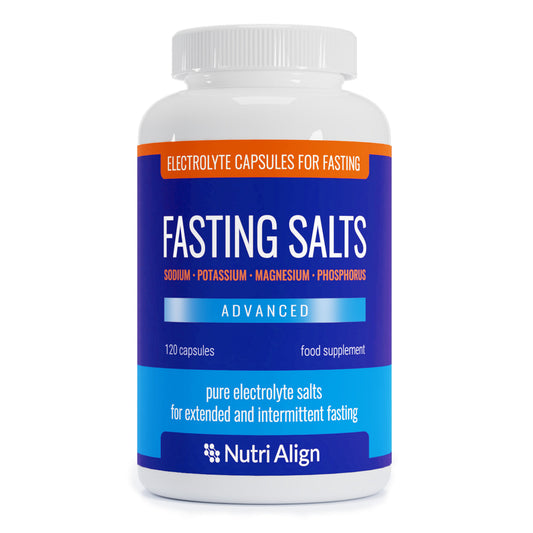
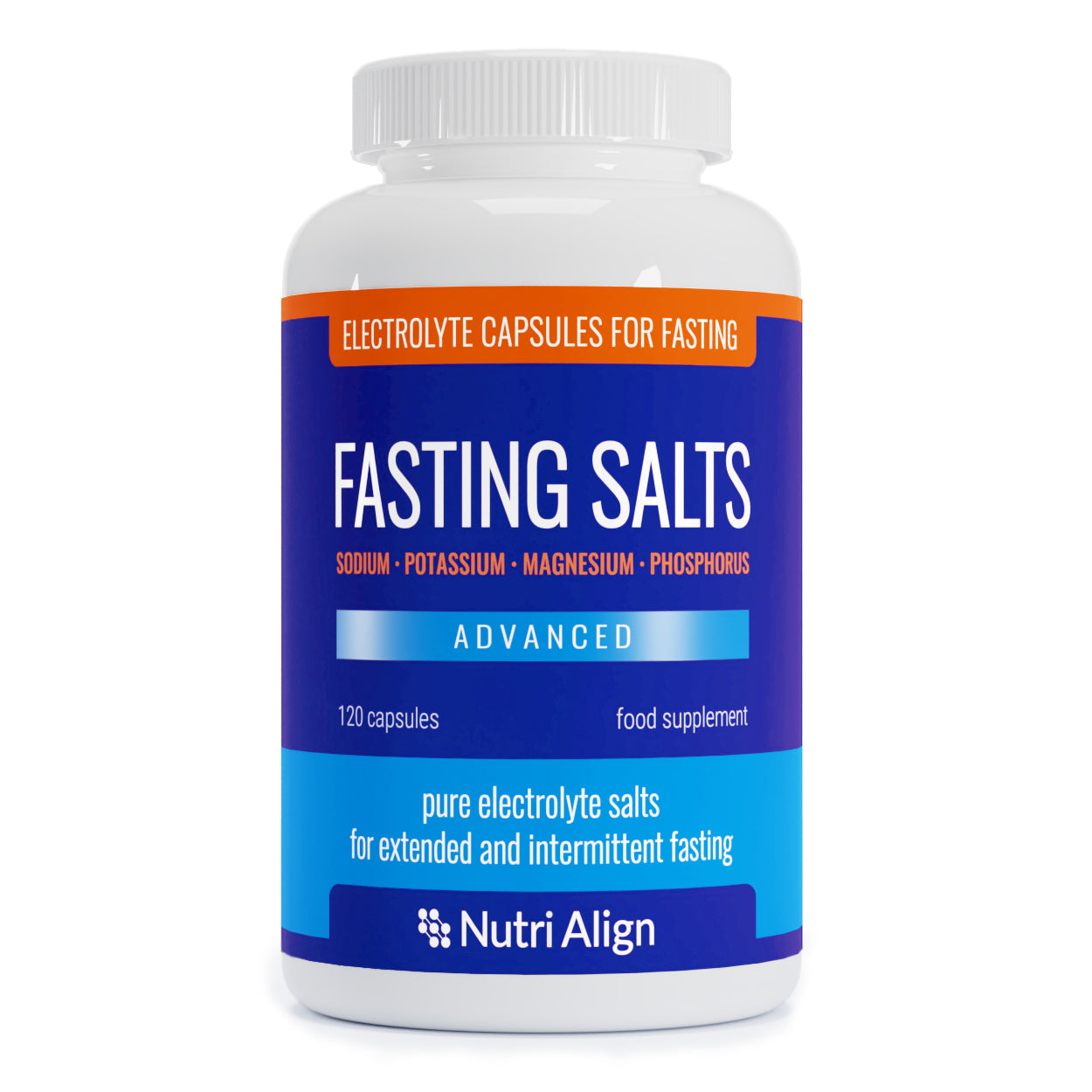
Our Fasting Salts products include pharmaceutical-grade pure dried vacuum salt made in Britain. We then add magnesium citrate and potassium chloride salts on top.
This composition ensures uniform levels of all key minerals in each serving of our supplement.
So that you get precisely the right amount of each electrolyte for optimal balance during your fast.
Sources
Fayet-Moore F, Wibisono C, Carr P, Duve E, Petocz P, Lancaster G, McMillan J, Marshall S, Blumfield M. An Analysis of the Mineral Composition of Pink Salt Available in Australia. Foods. 2020 Oct 19;9(10):1490. doi: 10.3390/foods9101490. PMID: 33086585; PMCID: PMC7603209.
T.Kuhn, P.Chytry, G.M.S.Souza, D.V.Bauer, L.Amaral, J.F.Dias Signature of the Himalayan salt, Science Direct, available online 9 July 2019


1 comment
Thanks, this was very helpful